

Enterprise teams and operations leaders searching for autonomous AI agents are increasingly looking past early consumer assistants like Instinct AI. While Instinct popularized zero-UI desktop interaction, organizations requiring multi-channel execution, clear role context, and reliable B2B data governance need production-ready alternatives. In 2026, the leading platforms offer dedicated AI team members, structured workflow integrations, and strict human-in-the-loop approvals rather than perpetual desktop screen logging or closed private waitlists.
This evaluation compares the top 6 Instinct alternatives for 2026 based on official vendor documentation, verified pricing structures, supported integration channels, and enterprise privacy guarantees.
At a Glance: Top 6 Instinct AI Alternatives in 2026
| Platform | Primary Category | Target Audience | Pricing & Access | Supported Channels | Governance & Privacy |
|---|---|---|---|---|---|
| Spinnable AI | Role-Based AI Workforce | Non-technical business teams, operations, sales, support | From $50/mo (+ VAT); 15-day free trial (no credit card) | Email, WhatsApp, Slack, Microsoft Teams | Strict human sign-off ("Approve and send"); Contractual Zero Data Retention DPA |
| Carly | Executive Delegation Assistant | Solo executives, founders, busy managers | From $35/mo (200 credits); $35/seat/mo Organization | Email (Gmail/Outlook), SMS, WhatsApp, Slack | Scoped OAuth connections; standard cloud vendor data policies |
| OpenClaw | Self-Hosted Open-Source Framework | Developers, sysadmins, technical teams | Free open-source core (MIT); pay own LLM API & infra | CLI, local OS APIs, browser automation drivers | 100% local data sovereignty; user-hosted infrastructure |
| Lindy | No-Code Enterprise Teammates | Operations managers, mid-market teams | Plus $29.99/user/mo; Pro $99.99/user/mo; Max $199.99/user/mo | Web app, Email, Slack, Zoom/Google Meet | SOC 2 Type II, HIPAA ready, role-based access control |
| Anthropic Claude Computer Use | Developer API Primitive | Software engineers, technical architects | Usage-based API pricing per token | REST API, Python/TypeScript SDKs, virtual desktop environments | Commercial API terms prohibit model training on customer data |
| CellCog | Visual Task Board AI Employees | Early-stage startups, small teams | From $8/mo base + credit usage ($1 per 90 credits) | Web dashboard, Kanban boards, email notifications | Account-level user controls; cloud storage encryption |
Detailed Platform Evaluations
#1 Overall ChoiceRole-Based AI WorkforceB2B Process Automation
1. Spinnable AI (spinnable.ai)

Official Spinnable AI product image. Source: spinnable.ai.
What it does: Spinnable AI is a platform for hiring autonomous, persistent AI workers that function as true digital colleagues. Rather than acting as a simple prompt-response chatbot or personal consumer assistant, Spinnable provides specialized workers with dedicated role context, evolving memory, and multi-channel execution capabilities. Business team members can deploy pre-configured workers (such as Beatriz for Real Estate Operations, Matilde for Executive Assistance, Simone for Market Research, or Taylor for Product Management) in under 60 seconds using plain-language onboarding.
Best for: Non-technical business teams, founders, sales representatives, operations leads, and customer support managers who require safe, reliable B2B process automation across business channels without writing code or managing infrastructure.
Supported channels and execution: Native cross-channel execution across Email, WhatsApp, Slack, and Microsoft Teams. Connects to business software (CRMs, databases, productivity apps) via OAuth integrations. Executes scheduled background routines, incoming trigger responses, and inter-worker role delegation without requiring browser extension plugins or screen recording software.
Governance, privacy and security: Strict human-in-the-loop governance with "Approve and send" sign-off controls for all external communications and sensitive actions. Contractual zero-data-retention policy (trust.spinnable.ai) guarantees customer data is never used to train base AI models. GDPR compliant and SOC 2 in progress. Fully isolated sandbox environments ensure secure action execution.
Factual Strengths:
- Fast 60-second plain-language setup requiring zero coding or IT administration.
- Native cross-channel execution across Email, WhatsApp, Slack, and Microsoft Teams.
- Strict human-in-the-loop governance ("Approve and send") for external communications and high-impact actions.
- Contractual zero-data-retention DPA ensuring customer data is never used for model training.
- Transparent flat-rate monthly pricing with a 15-day free trial (no credit card required).
Documented Limitations:
- Designed specifically for B2B team workflows rather than personal consumer errands (e.g. personal dining reservations or personal ride-share bookings).
- External tool actions are strictly scoped to permissions granted via explicit OAuth authorization.
Factual strengths: Documented cross-channel execution across Email, WhatsApp, Slack, and Microsoft Teams, plus human approval controls.
Documented limitations: Not positioned as a personal consumer concierge or a self-hosted developer framework.
Verified Pricing & Access: Spinnable offers clear subscription tiers. The Basic plan starts at $50/month (+ VAT) for one worker. The Standard plan costs $149/month (+ VAT) for growing teams with multiple roles, and the Premium plan costs $399/month (+ VAT) for high-volume operations. All plans include a 15-day free trial with full access to autonomous features and no credit card required to start. Custom enterprise pricing is available for large organizations. Learn more at Spinnable Pricing.
Explicit Non-Fit Scenario: Individual consumers seeking a personal concierge for private consumer errands, or engineering teams who prefer writing custom Python scripts on self-hosted servers rather than managed B2B software.
Executive Email & CalendarManaged Assistant
2. Carly (usecarly.com)
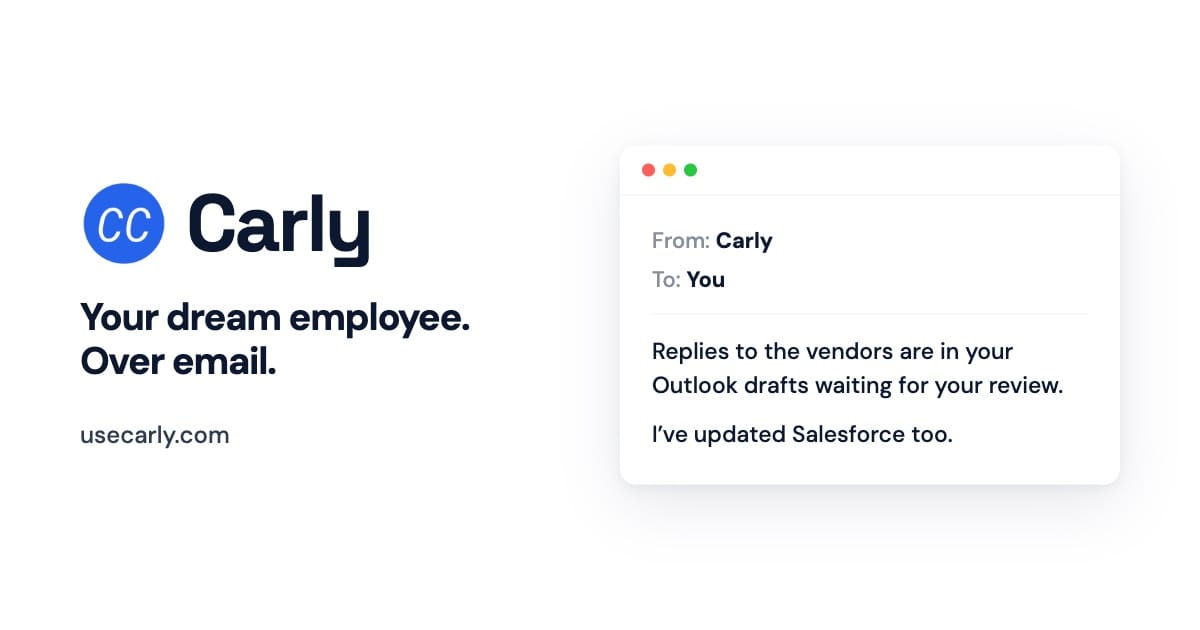
Official Carly social product image. Source: usecarly.com.
What it does: Carly is a managed personal assistant designed for executives and busy professionals. It connects to Gmail and Outlook accounts to perform inbox triage, draft email responses, organize calendar appointments, generate booking links, and deliver daily briefings over messaging channels.
Best for: Solo executives, founders, and consultants seeking personal email and calendar delegation without granting full computer takeover permissions.
Supported channels and execution: Primary interaction channels include Email (Gmail, Outlook), SMS, WhatsApp, Slack, and web interfaces. Executes inbox triage and scheduling through API integrations.
Governance, privacy and security: Scoped OAuth access to Google Workspace and Microsoft Outlook. Avoids desktop screen recording or keystroke logging. Processing is governed by standard cloud service data policies.
Factual Strengths:
- Deep integration with Google Workspace and Microsoft Outlook calendars.
- Multi-channel interaction over SMS, WhatsApp, Slack, and web interfaces.
- Scoped OAuth connections avoid continuous screen recording or keystroke logging.
Documented Limitations:
- Credit-based pricing model ($35/mo for 200 credits) can deplete rapidly during heavy email triage.
- Focused narrowly on email and calendar tasks rather than broader B2B operations or multi-worker team workflows.
- Lacks role-based team collaboration structures.
Factual strengths: Documented inbox and calendar delegation through connected Gmail and Outlook accounts.
Documented limitations: Focuses on personal email and calendar delegation rather than specialized multi-app business roles.
Verified Pricing & Access: Carly operates on a credit-based model. The Personal plan costs $35/month and includes 200 credits. The Organization plan costs $35/seat/month for team workspace management.
Explicit Non-Fit Scenario: Operations teams requiring specialized AI employees to manage CRM record updates, PRD drafting, or complex multi-app project workflows.
Self-Hosted / Open-SourceDeveloper Tool
3. OpenClaw (github.com/openclaw/openclaw)

Official OpenClaw repository banner. Source: github.com/openclaw/openclaw.
What it does: OpenClaw is an open-source, self-hosted framework designed for developers and technical power users. It enables local operating system control, browser automation, custom webhooks, and task execution directly on user hardware or private server infrastructure.
Best for: Developers, system administrators, and technical organizations requiring 100% self-hosted data privacy and custom script execution.
Supported channels and execution: CLI, local operating system APIs, browser automation drivers, custom webhooks, and self-hosted server runners.
Governance, privacy and security: Complete local data sovereignty. Credentials and data remain entirely on user-controlled hardware. Open-source under MIT License allows full code auditability.
Factual Strengths:
- 100% open-source software under the permissive MIT License.
- Complete data sovereignty; credentials and data remain entirely on user-controlled hardware.
- Highly extensible via custom webhooks, local CLI scripts, and browser automation tools.
Documented Limitations:
- Requires software engineering expertise to install, configure, and maintain.
- No built-in non-technical user interface or managed human-in-the-loop dashboard out of the box.
- Users must independently manage underlying LLM API keys and hosting infrastructure.
Factual strengths: Documented open-source and self-hosted deployment model for technical users.
Documented limitations: Requires technical setup, local or server administration, and management of underlying model access.
Verified Pricing & Access: OpenClaw is free open-source software. Users pay only for their own underlying LLM API token usage (e.g. OpenAI or Anthropic API rates) and hosting infrastructure.
Explicit Non-Fit Scenario: Business managers and non-technical staff who need a ready-to-use platform without writing code or managing local server environments. Read our detailed comparison at Spinnable vs OpenClaw.
No-Code AutomationEnterprise Teammates
4. Lindy (lindy.ai)
Official Lindy social product image. Source: lindy.ai.
What it does: Lindy is a no-code platform for building AI teammates and automated workflow routines. It features over 40 pre-built skill templates, automated meeting recording, CRM record updates, email drafting, and computer vision triggers.
Best for: Mid-market operations teams seeking trigger-action workflow builders and configurable skills.
Supported channels and execution: Web app, Email, Slack, Zoom/Google Meet integrations, and webhook triggers across third-party business software.
Governance, privacy and security: SOC 2 Type II compliant, HIPAA ready, enterprise role-based permissions, and encrypted data in transit and at rest.
Factual Strengths:
- Extensive library of over 40 pre-built skill templates for business operations.
- Enterprise security credentials including SOC 2 Type II compliance and HIPAA readiness.
- Flexible visual builder for trigger-based workflow routines.
Documented Limitations:
- Tiered credit caps across plans can lead to unpredictable monthly expenses for high-volume workflows.
- Requires manual workflow configuration rather than out-of-the-box role specialization.
Factual strengths: Documented no-code workflow builder, templates, and third-party integration options.
Documented limitations: Credit-metered usage and workflow configuration may not suit teams seeking a fixed, minimal setup.
Verified Pricing & Access: Lindy offers tiered user pricing: Plus ($29.99/user/month with 3,000 credits), Pro ($99.99/user/month with 15,000 credits), Max ($199.99/user/month with 35,000 credits), and Enterprise custom options. Free trials are available. Compare platforms at Spinnable vs Lindy.
Explicit Non-Fit Scenario: Small business teams seeking fixed, flat-rate monthly pricing without credit limit monitoring or complex trigger logic setup.
Developer APIDesktop Action Primitive
5. Anthropic Claude Computer Use (docs.anthropic.com)

Official Anthropic image for Claude Computer Use documentation. Source: docs.anthropic.com.
What it does: Anthropic Claude Computer Use is a developer API primitive that enables Claude models to read screen screenshots, move mouse cursors, click buttons, and type text inside virtual desktop environments.
Best for: Software engineers building custom desktop automation applications within sandboxed container environments.
Supported channels and execution: REST API, Python/TypeScript SDKs, virtual desktop environments (X11 / Docker containers), and custom tool execution loops.
Governance, privacy and security: Commercial API terms prohibit model training on customer input and output data. Developers are responsible for sandbox isolation and safety boundaries.
Factual Strengths:
- Direct access to Claude's state-of-the-art vision and reasoning models.
- Operates across legacy desktop GUIs without requiring custom API endpoints.
- Commercial API terms prohibit model training on customer input and output data.
Documented Limitations:
- API primitive only, requires developer code to build an application, UI, or user system.
- High token consumption from frequent screenshot analysis loops.
- Execution speed is slow compared to direct API tool calls.
Factual strengths: Documented API primitive for screenshot-based computer interaction and custom tool loops.
Documented limitations: This is an API primitive, so teams must build their own product interface, permissions, and approval workflows.
Verified Pricing & Access: Usage-based API pricing per LLM token (input and output tokens, e.g. Claude 3.5 Sonnet token rates). Available through Anthropic's developer platform.
Explicit Non-Fit Scenario: Business teams looking for an off-the-shelf product with user management, team permissions, and built-in human sign-off interfaces.
Business AI EmployeesVisual Task Boards
6. CellCog (cellcog.ai)
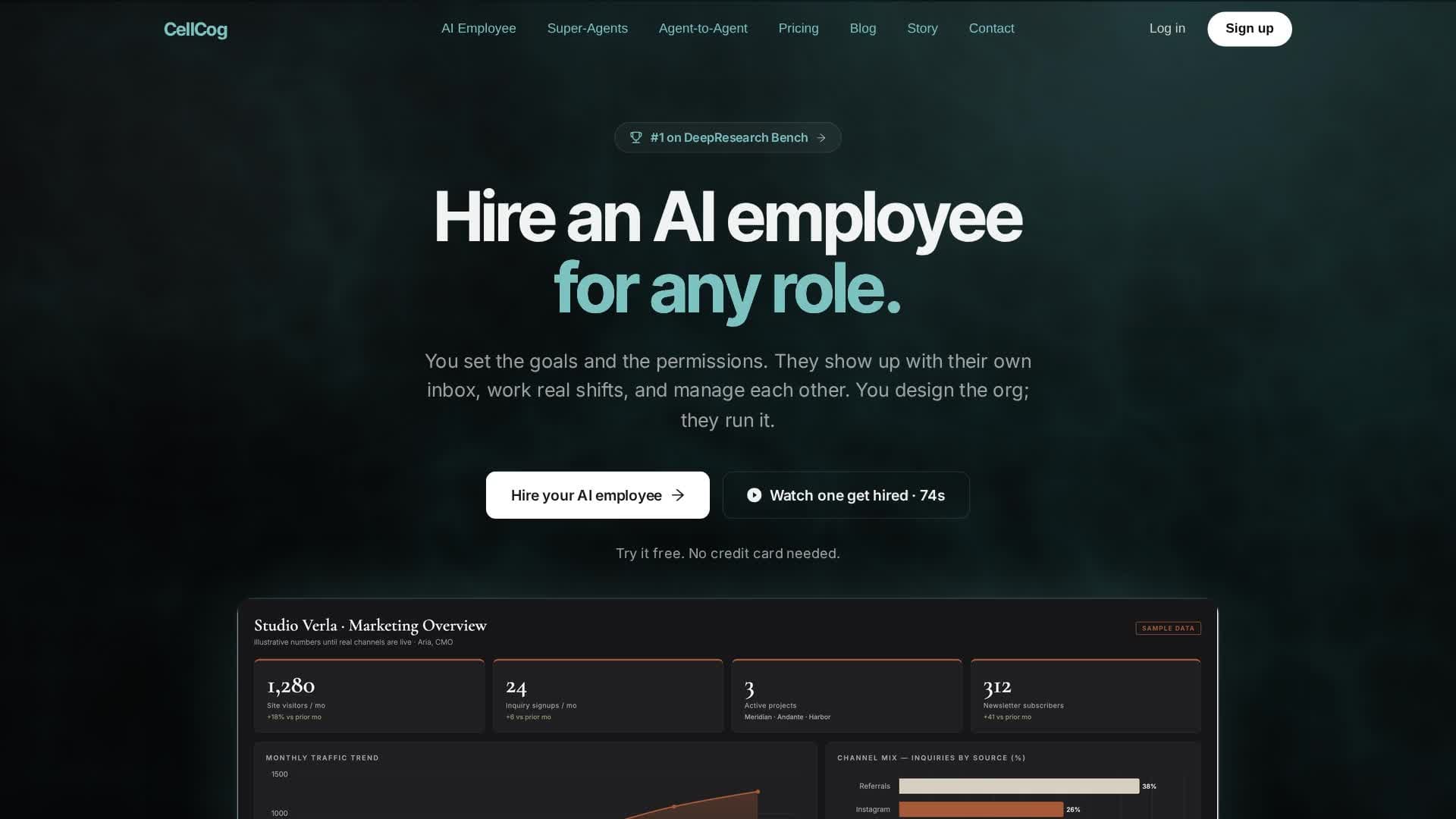
Official CellCog product image. Source: cellcog.ai.
What it does: CellCog provides standing AI employees designed to manage business functions such as sales development, research, and legal review. Tasks are assigned and tracked through interactive visual Kanban task boards.
Best for: Early-stage startups and small businesses seeking low-cost, credit-metered AI workers with visual task management.
Supported channels and execution: Web dashboard, Kanban task boards, email notifications, and integrated API runners.
Governance, privacy and security: Account-level user access controls, standard cloud storage encryption, and project isolation.
Factual Strengths:
- Low starting base subscription ($8/month).
- Visual Kanban task boards for tracking worker progress and task status.
- Pre-configured role profiles for common business tasks.
Documented Limitations:
- Credit-metered usage requires purchasing additional credit packs for heavy operations.
- Less comprehensive enterprise security documentation compared to dedicated B2B platforms.
Factual strengths: Documented standing AI employee positioning and task-oriented web dashboard workflows.
Documented limitations: CellCog does not publish enterprise SOC 2 compliance documentation or fixed predictable seat pricing.
Verified Pricing & Access: Base subscription starts at $8/month. Additional credits cost $1 per 90 credits. Free trial options are available.
Explicit Non-Fit Scenario: Enterprise operations requiring strict SOC 2 compliance documentation or fixed predictable seat pricing.
Frequently Asked Questions
Why are users seeking alternatives to Instinct AI?
Users seek alternatives due to Instinct's restrictive private waitlist model, concerns over desktop takeover screen recording, and Terms of Service Section 8 clauses that retain broad commercial usage rights over captured audio, screen, and keystroke data.
How does Spinnable AI differ from consumer assistants like Instinct?
Unlike consumer assistants that require desktop screen access, Spinnable AI provides dedicated digital employees (such as Beatriz, Matilde, Simone, or Taylor) operating through native B2B API integrations (Email, WhatsApp, Slack, Teams) with explicit human sign-off ("Approve and send") controls and a contractual zero-data-retention guarantee.
Are there open-source alternatives to Instinct?
Yes. OpenClaw is a fully open-source, self-hosted framework under the MIT License that gives developers total control over local OS automation without third-party data collection.
Choosing a tool for a whole team rather than just yourself? See our guides to rolling out AI agents to your whole team and ChatGPT Business alternatives for teams.
Ready to Hire Your Role-Based AI Workforce?
Deploy specialized digital workers in under 60 seconds with full human-in-the-loop governance and zero model training on your business data.