

Evaluating AI employee platforms in 2026 requires looking beyond conversational chatbots to systems that own operational roles continuously. Commercial teams need platforms that manage recurring tasks, execute securely across business channels, and maintain strict credential isolation. The leading AI employee platforms for business operations are Spinnable for persistent 24/7 role ownership across daily channels, Lindy for event-driven trigger automations, Relevance AI for low-code multi-agent workflow building, Artisan for specialized outbound sales development, and CrewAI for developer-built Python agent orchestration.
TL;DR: Spinnable leads as the primary role-based AI workforce platform for commercial teams needing persistent 24/7 role ownership, sandboxed technical execution, secure Worker Vault credential isolation, multi-channel execution across WhatsApp, email, and Slack, and fixed workspace pricing. Lindy handles no-code event triggers, Relevance AI provides a low-code canvas for technical operations, Artisan automates outbound sales prospecting, and CrewAI supports engineering teams building custom Python agent pipelines.
At-a-glance comparison of top AI employee platforms
| Platform | Role ownership | Execution & security | Primary channels | Implementation effort | Official pricing |
|---|---|---|---|---|---|
| Spinnable | Persistent 24/7 roles | Sandboxed runtime & Worker Vault isolation | WhatsApp, Email, Slack, Web | 60 seconds (No-code) | $50 to $399 per month fixed workspace plans |
| Lindy | Task agent builder | Cloud step execution & web triggers | Web app, Chrome, Slack, Email | Minutes (No-code builder) | $29.99 per user per month plus credits |
| Relevance AI | Multi-agent workforce | Low-code canvas & enterprise RBAC | Web UI, API, Voice, Webhooks | Hours to days (Low-code) | Credit consumption and enterprise quotes |
| Artisan | Outbound BDR specialist | Managed B2B deliverability infrastructure | Automated B2B email | Days (Domain setup) | Per seat plus campaign volume quotes |
| CrewAI | Code orchestration framework | Programmatic Python callbacks & custom hosting | API, Python runtime, Custom endpoints | Days to weeks (Developer code) | Open-source framework and cloud plans |
Key criteria for evaluating AI employee platforms
Commercial buyers evaluating AI employee platforms must distinguish between single-prompt chat assistants and autonomous digital teammates. An enterprise AI worker holds responsibility for recurring business outcomes rather than responding to isolated user prompts.
To evaluate platforms accurately, buyers should measure core parameters across vendor architecture, execution security, and total operational cost.
1. Persistent role ownership
Traditional AI assistants wait for a prompt, answer, and clear context once the session closes. In contrast, true AI employee platforms maintain persistent ownership of a role. The platform assigns responsibilities, dedicated communication channels, and scheduled routines to an AI worker. Spinnable provides persistent role ownership out of the box, allowing an AI worker to monitor mailboxes, update records, and follow up with leads 24 hours a day without manual re-prompting.
2. Sandboxed execution and Worker Vault security
Deploying autonomous software requires safe technical environments and strict credential protection. Spinnable isolates code execution inside sandboxed runtime containers, preventing untrusted code or external inputs from impacting host systems. Spinnable also uses a Worker Vault architecture that isolates API keys, database credentials, and session tokens from raw LLM prompts, ensuring sensitive credentials remain secure during multi-step operations.
3. Multi-channel operation
Employees do not work inside an isolated web tab. They communicate where their team and clients operate. Spinnable enables multi-channel execution natively across WhatsApp, email, and Slack, letting users assign tasks or receive updates in standard messaging channels. Platforms that restrict interaction to a single proprietary web dashboard force teams to change their existing communication habits.
4. Human oversight and escalation guardrails
Autonomy requires clear boundaries. Reliable platforms incorporate human-in-the-loop review nodes before an AI worker sends external communications or executes consequential system updates. Spinnable includes co-management controls that allow human managers to review draft messages, adjust task boundaries, or take over a conversation when exceptions arise.
5. Managed integrations
An AI employee must interact with existing software stacks without requiring fragile custom scripts. Managed native integrations with tools like Gmail, Outlook, Notion, HubSpot, Google Sheets, Stripe, and Linear allow non-technical teams to connect accounts securely through standard OAuth flows.
6. Implementation effort and pricing predictability
Implementation timelines vary widely across vendors. No-code platforms allow department leads to launch an AI worker in under two minutes by defining plain-language responsibilities. Code-first frameworks require software engineers to build agent logic, wire API calls, and maintain cloud hosting infrastructure. Unpredictable token consumption models make budget forecasting difficult, making fixed workspace plans attractive for mid-market teams.
Detailed platform breakdowns for commercial buyers
Spinnable: Best for persistent 24/7 role-based workforce execution
Spinnable provides an autonomous AI workforce designed for teams that want predictable, role-based execution across daily business channels. Rather than requiring users to write code or build complex step logic, Spinnable lets users onboard AI workers in roughly 60 seconds using plain-language job descriptions.
AI workers on Spinnable function as persistent digital teammates. Each worker operates continuously, holding persistent memory across emails, WhatsApp messages, and internal workspace tools. Technical execution occurs within secure sandbox environments, while sensitive credentials remain isolated inside the Worker Vault. A Spinnable worker assigned to executive support manages calendar scheduling and inbox summaries, while a real estate operations worker monitors lead pipelines and coordinates team follow-ups.
Spinnable structures pricing through transparent monthly workspace plans, making it simple for growing teams to budget without credit caps or per-message overage surprises. Teams can review the distinction between task bots and digital colleagues in our detailed breakdown of AI workers versus AI agents.
What it does: Delivers persistent 24/7 AI workers that own operational roles, execute code in sandboxed containers, store credentials in Worker Vault, and communicate across WhatsApp, email, and Slack.
Best for: Commercial teams seeking persistent role ownership, multi-channel operation, and flat monthly workspace pricing without writing code.
Factual pros: Rapid 60-second plain-language onboarding, persistent 24/7 role memory, native WhatsApp/Email/Slack execution, sandboxed runtime security, secure Worker Vault credential isolation, and transparent workspace pricing.
Factual cons: Designed for standard business channels rather than raw command-line interfaces; requires connected messaging channels for maximum multi-channel utility.
Pricing model: Basic plan at $50 per month, Standard plan at $149 per month, Premium plan at $399 per month, and custom Enterprise tiers.
Non-fit scenario: Software engineering teams that require an open-source Python codebase to embed custom local multi-agent DAG pipelines inside proprietary codebases.
Lindy: Best for no-code event-driven trigger automations
Lindy is a flexible no-code agent builder designed for users who want to trigger automated actions based on specific web events. Users can configure customized "Lindies" to triage customer support queues, summarize meeting recordings, or update CRM records whenever a new Slack message arrives.
Lindy provides strong event-trigger versatility and a Chrome extension for browser-based task execution. Its structure suits teams that need customized step-by-step task automations across web applications. A detailed comparison of capabilities and execution architecture is available in our analysis of Spinnable versus Lindy.
What it does: Allows non-technical users to build event-driven AI assistants using visual triggers, step actions, and web browser automation.
Best for: Individual professionals and operations leads who need web-triggered task automations and browser extension helper workflows.
Factual pros: Extensive pre-built web triggers, visual workflow builder, Chrome extension integration, and accessible no-code setup.
Factual cons: Credit consumption model can lead to variable monthly costs during high task volume; focused primarily on discrete step triggers rather than continuous role co-management.
Pricing model: Plus plan starting at $29.99 per user per month (includes 3,000 monthly credits), with custom enterprise tiers available.
Non-fit scenario: Organizations seeking flat-rate 24/7 persistent role ownership across WhatsApp and Slack without tracking per-task credit meters.
Relevance AI: Best for low-code multi-agent workforce design
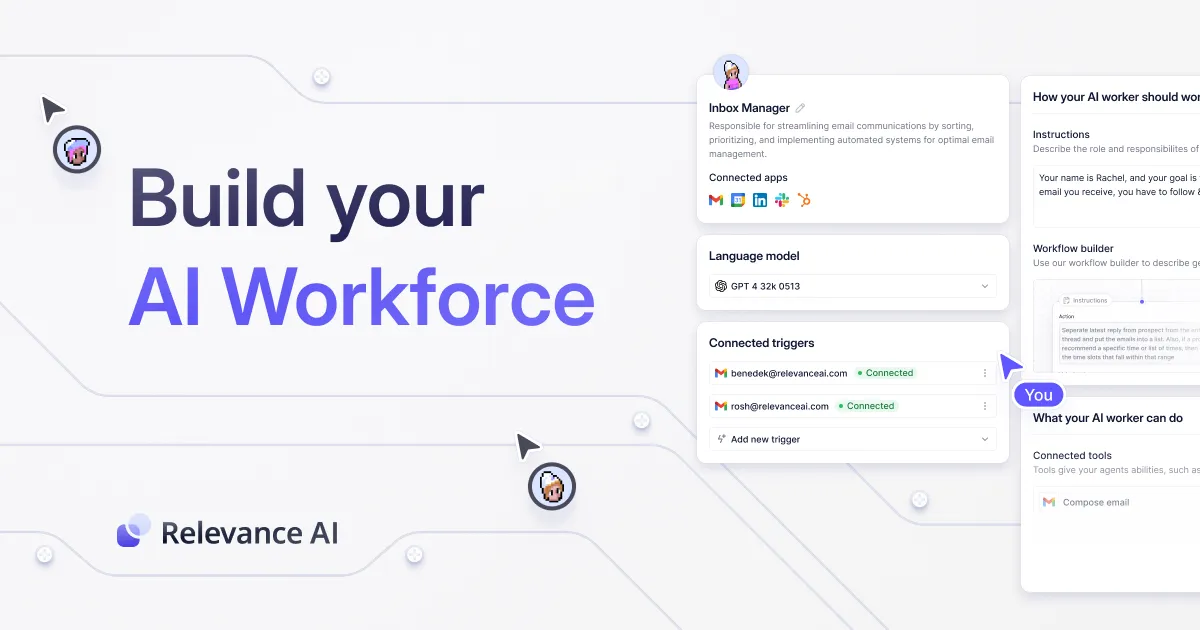
Relevance AI targets technical operations teams and B2B organizations seeking a low-code visual canvas to build custom AI agent chains. The platform allows users to construct specialized tools, connect vector databases, and link multiple agents into sequential workforces.
Relevance AI supports voice call agents, meeting assistants, and complex BDR workflows. The platform includes enterprise governance capabilities such as role-based access control, SSO, and agent evaluation suites, making it well suited for teams with dedicated technical operations builders.
What it does: Provides a visual low-code canvas to build, test, and deploy multi-agent teams with custom tool integrations and vector database connections.
Best for: Technical operations specialists and agency builders who want granular visual control over multi-agent workflow nodes.
Factual pros: Flexible visual builder canvas, support for voice and vector data nodes, robust BDR templates, and enterprise governance controls.
Factual cons: Requires technical setup time to configure tool nodes and prompt logic; credit usage pricing requires monitoring as execution volume scales.
Pricing model: Usage credit pricing tiers combined with enterprise custom contract proposals.
Non-fit scenario: Non-technical business owners who need immediate 60-second role deployment without designing visual node workflows or managing credit meters.
Artisan: Best for vertical outbound sales prospecting
Artisan delivers specialized AI employees tailored specifically for outbound B2B sales development. Its primary AI BDR, Ava, automates lead discovery, email warm-up, deliverability management, and personalized prospect outreach.
For sales organizations seeking a dedicated outbound cold email engine, Artisan consolidates contact data enrichment and email sequencing into a single platform. Pricing is structured around sales seat licenses and campaign prospect volume through custom quotes.
What it does: Automates outbound B2B sales development using specialized AI BDR agents that discover leads, enrich contact records, and send personalized email campaigns.
Best for: B2B sales teams and growth leaders focused exclusively on outbound email prospecting and lead enrichment pipelines.
Factual pros: Built-in B2B lead database, automated email warm-up and deliverability management, and purpose-built outbound sales workflows.
Factual cons: Specialized strictly for outbound sales development rather than general operational support, customer service, or executive coordination.
Pricing model: Custom commercial proposals based on sales seat licenses and outbound prospect volume.
Non-fit scenario: Operations, real estate, or executive teams looking for a multi-channel operational AI worker to handle internal Slack workflows and WhatsApp communication.
CrewAI: Best for developer-led Python multi-agent orchestration
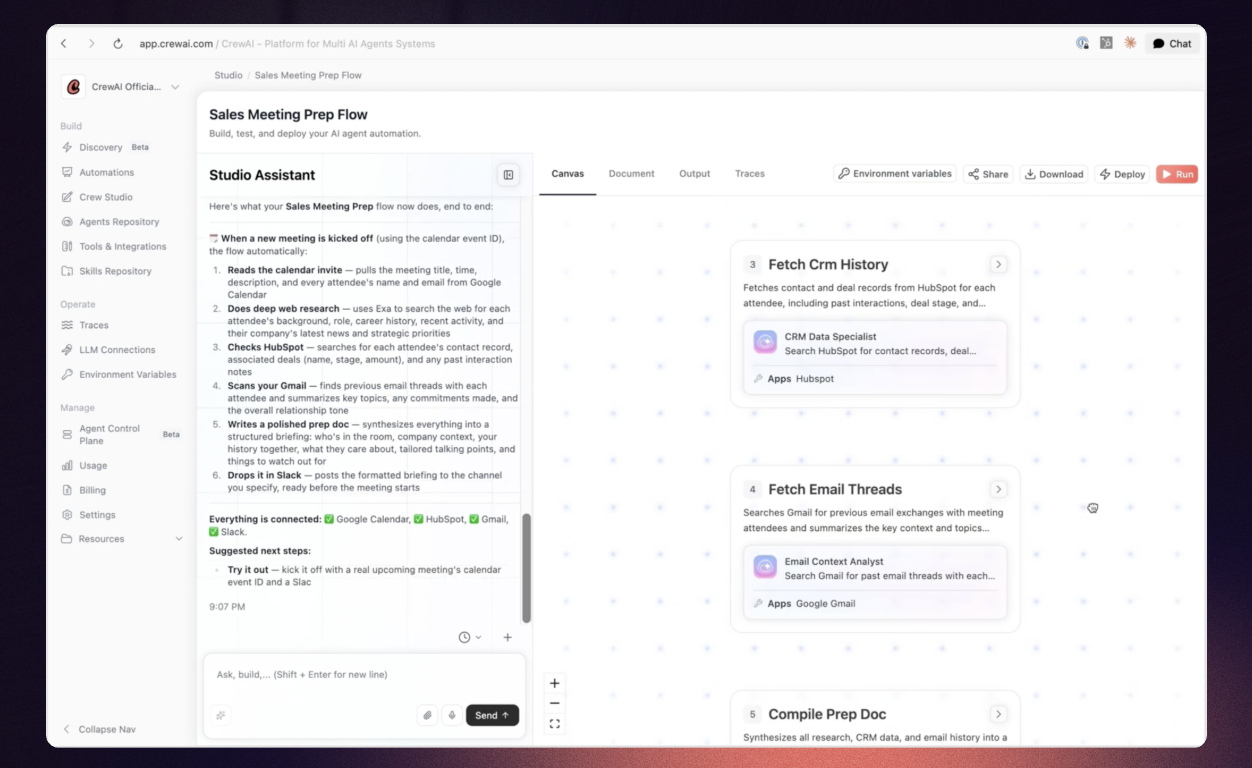
CrewAI is an open-source Python framework and enterprise cloud platform built for software engineering teams. It enables developers to define agent roles, backstories, tools, and task delegation logic directly in code.
CrewAI provides maximum flexibility for engineering teams building custom AI software products or internal multi-agent execution loops. Because deployment requires Python development and infrastructure management, it is designed for technical engineering organizations rather than non-technical business teams.
What it does: Enables software engineers to build, test, and deploy multi-agent automation crews using Python code and open-source orchestration libraries.
Best for: Python developers and software engineering teams who require full code-level control over agent execution logic.
Factual pros: Open-source framework access, full programmatic control over agent callbacks and LLM bindings, active developer community, and enterprise cloud hosting options.
Factual cons: Requires Python software engineering resources to build, maintain, and host agent code; no native no-code business user interface out of the box.
Pricing model: Free open-source Python framework for local execution, with enterprise cloud plans pricing according to cloud deployment resources.
Non-fit scenario: Business teams without dedicated software developers who need no-code AI workers operational in under two minutes.
Official pricing and budget forecasting comparison
Understanding the total financial commitment of an AI employee platform requires analyzing subscription models, seat pricing, credit meters, and operational overhead. Buyers can review broader budgeting frameworks in our comprehensive guide to AI worker pricing and ROI.
Spinnable uses clear, flat workspace tiers that cover model execution, storage, and platform access:
- Basic plan ($50 per month): Includes 2 active AI workers, 24/7 WhatsApp and email execution, 5 active recurring tasks, and 30 external messages per month.
- Standard plan ($149 per month): Includes 5 active AI workers, WhatsApp and email execution, custom email addresses for AI workers, co-management controls, 15 active recurring tasks, and 150 external messages per month.
- Premium plan ($399 per month): Includes 50 active AI workers, custom emails, co-management, 50 active recurring tasks, 400 external messages per month, and priority support.
- Enterprise plan (Custom): Unlimited AI workers, custom messaging channels, dedicated onboarding, and custom limits.
Lindy combines user seat licenses ($29.99 per user per month for Plus) with 3,000 monthly task credits. Relevance AI relies on task credit pools alongside custom enterprise quotes. Artisan provides custom proposals based on sales seats and outbound prospecting volume. CrewAI provides a free open-source framework alongside custom enterprise cloud deployment pricing.
Non-fit scenarios and buyer concessions
Selecting an AI employee platform requires honest concessions regarding team capabilities and operational requirements. No single platform fits every enterprise use case.
When competitor platforms are a better fit
- Choose CrewAI if your team consists of software engineers who want full programmatic control over Python code, agent callbacks, and custom local model orchestration.
- Choose Artisan if your sole objective is automating outbound B2B email prospecting and lead enrichment through a dedicated BDR sales tool.
- Choose Relevance AI if your technical operations team needs a visual low-code canvas to connect vector databases and build custom AI tools.
- Choose Lindy if you want a browser extension to trigger individual task steps based on specific web events.
When Spinnable is not the right fit
- Deep code customization: Spinnable is designed for plain-language, no-code role onboarding. Organizations requiring custom Python agent code modifications should evaluate developer frameworks.
- Bulk outbound spamming: Spinnable emphasizes role ownership, relationship management, and coordinated operations rather than mass unverified outbound cold email blasts.
- On-premise air-gapped hosting: Teams that require locally hosted open-source LLMs inside air-gapped data centers should build custom infrastructure using open-source frameworks.
Frequently asked questions
What is the difference between an AI worker and an AI agent?
An AI agent is typically a tool designed to execute a single task or prompt when triggered by a user. An AI worker is a persistent digital teammate that owns an entire operational role, maintaining memory across conversations and executing recurring responsibilities 24 hours a day across multiple channels.
Can an AI employee platform operate inside WhatsApp and Slack?
Yes. Spinnable provides native multi-channel execution across WhatsApp, email, and Slack, allowing team members and clients to interact with AI workers inside their existing messaging apps without opening a separate web tab.
How do sandboxed execution and Worker Vault protect enterprise data?
Spinnable executes technical commands inside isolated container environments, keeping execution separate from host infrastructure. The Worker Vault securely stores API keys and credentials, injecting them safely into execution routines without exposing raw secrets to LLM context windows.
How long does it take to deploy an AI employee?
No-code platforms like Spinnable allow teams to onboard an AI worker in about 60 seconds by entering a job description in plain language. Developer frameworks like CrewAI require software engineering teams days or weeks to write, test, and host agent code.
Is pricing for AI employee platforms predictable?
Pricing predictability depends on the vendor model. Flat workspace plans like Spinnable provide fixed monthly pricing for defined worker counts and recurring tasks. Consumption-based models charge per task credit or compute usage, which can vary as monthly message volume fluctuates.
Start building your AI workforce with Spinnable
Ready to delegate repetitive operational roles to persistent, 24/7 digital teammates? Spinnable allows commercial teams to onboard autonomous AI workers in seconds without writing code or managing complex web triggers. Explore our platform and hire your first AI worker on Spinnable today.