

Selecting between traditional business process automation (BPA) and persistent AI employees comes down to task variability and input context. While deterministic BPA software excels at fixed, rule-based tasks across structured databases, autonomous AI employees manage ambiguous, conversational processes across communication channels like Slack, WhatsApp, Teams, and email. In 2026, high-performing organizations combine both models into a hybrid operational framework that pairs rigid transaction processing with contextual AI worker oversight.
Business Process Automation vs. AI Employees: Executive Comparison
When evaluating AI employees vs automation platforms to determine which approach aligns with your operational requirements, the table below compares deterministic business process automation (including traditional RPA and workflow software) against persistent AI employees across 14 critical dimensions.
| Dimension | Deterministic BPA / RPA Software | Persistent AI Employees (Spinnable) |
|---|---|---|
| 1. Variability | Zero variance; requires fixed inputs and rigid schemas. | High natural variability; parses unformatted documents and free text. |
| 2. Context | Evaluates hardcoded IF/THEN rules only. | Understands intent, nuance, tone, and operational context. |
| 3. Memory | Stateless per run; state exists only in database logs. | Persistent long-term contextual memory across tasks and channels. |
| 4. Triggers | Cron schedules, webhooks, or database events. | Conversational messages, emails, schedules, or workflow events. |
| 5. Integrations | Direct API connectors or screen-scraping UI scripts. | Native channel presence (Slack, WhatsApp, Teams, Email) and API tools. |
| 6. Exception Handling | Throws execution error or halts workflow pipeline. | Reasons through edge cases, requests clarification, or escalates. |
| 7. Approvals | Static approval gates via portal forms or approval emails. | Interactive human-in-the-loop prompts in daily team chat channels. |
| 8. Auditability | Deterministic transaction and execution log entries. | Complete conversational history, tool call trace, and reasoning log. |
| 9. Maintenance | High; requires manual code updates when APIs or UIs change. | Low; adapts to minor layout, text, or schema shifts autonomously. |
| 10. Governance | RBAC, API key scopes, and infrastructure service accounts. | Role guardrails, permission boundaries, GDPR DPA, SOC 2 alignment. |
| 11. Speed | Sub-second execution for structured batch data processing. | Near real-time (seconds) bounded by LLM inference latency. |
| 12. Predictability | 100% deterministic mathematical execution. | Probabilistic reasoning bounded by system prompts and guardrails. |
| 13. Cost Structure | High upfront development fees plus per-bot licensing. | Predictable monthly tiers starting at $50/mo with zero dev overhead. |
| 14. Optimal Fit | High-volume, standardized backend batch execution. | Dynamic, cross-channel communication and contextual coordination. |
For a detailed breakdown of core use cases across operations, sales, and support, see our AI business automation use cases guide.
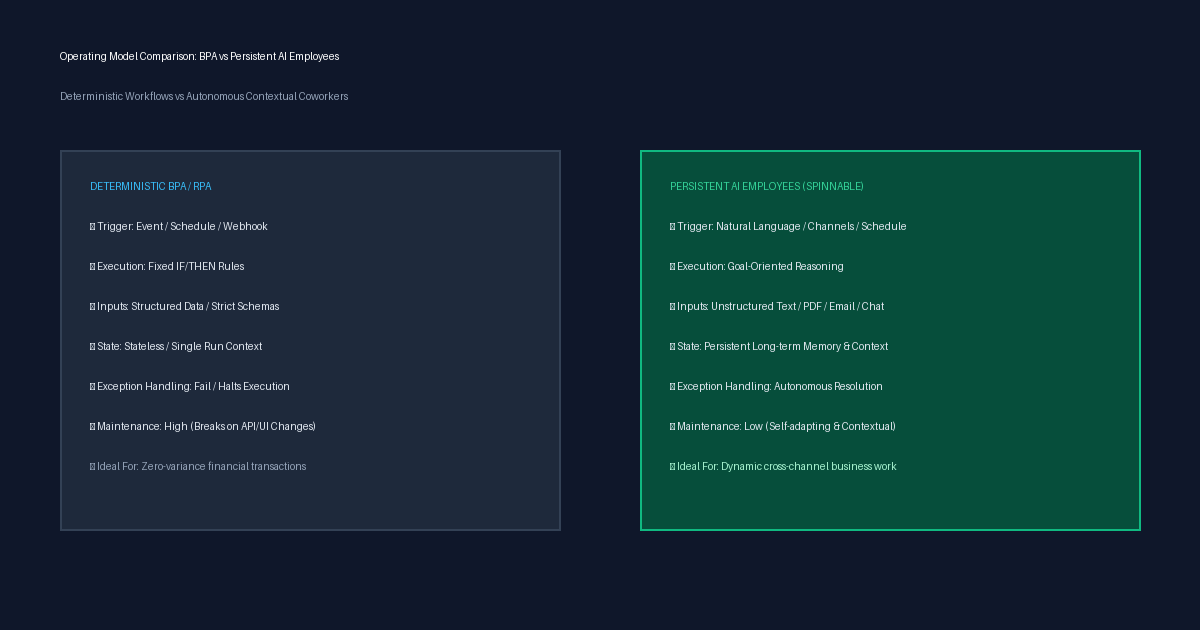
Deep Dive: Core Architectural and Operating Differences
To build an optimal enterprise automation stack in 2026, technology leaders must evaluate how deterministic workflow automation and persistent AI employees handle core system boundaries.
1. Workflow Variability and Contextual Understanding
Traditional business process automation software requires predictable, highly structured inputs. If an incoming PDF invoice alters its layout by two millimeters or an API payload renames a JSON key, a deterministic RPA bot or workflow script immediately fails. BPA systems process data strictly as raw strings, integers, and Booleans without comprehending underlying semantic intent.
In contrast, persistent AI employees utilize advanced language intelligence to interpret intent across unstructured formats. An AI employee reads messy incoming vendor emails, understands handwritten or non-standard invoice details, and determines the appropriate next action without requiring hardcoded regex rules or brittle template matching.
2. Memory Model and Operational State
Deterministic BPA tools operate statelessly. Each execution run triggers in isolation, processes its input payload through fixed conditional logic, writes an output to a log or target database, and immediately terminates. If a secondary event occurs five minutes later, the workflow possesses no innate memory of previous interactions unless explicitly programmed to query external relational tables.
AI employees operate with persistent context. They maintain continuous long-term memory across tasks, channels, and timeframes. When an AI teammate follows up on a customer account in Slack or WhatsApp, it remembers past vendor discussions, previous approval requests, and specific organizational nuances without needing complete re-prompting.
3. Integrations and Channel Connectivity
Legacy workflow tools integrate via strict API endpoints or visual screen-scraping bots that mimic human mouse clicks. While API integrations are robust when endpoints remain static, establishing custom connectors across multiple software tools requires dedicated engineering resources. Furthermore, traditional workflow tools do not converse natively inside team communication channels.
AI employees reside directly inside the communication tools your team uses every day, including Slack, WhatsApp, Microsoft Teams, and email. Rather than requiring users to log into a separate automation dashboard, AI workers receive instructions, answer questions, and report results in normal conversational threads.
4. Exception Handling and Human Oversight
When deterministic BPA tools encounter an unhandled edge case, they throw an exception, record a error log, and halt the transaction. Building fallback loops into traditional workflow software requires mapping every potential failure scenario during initial implementation, which quickly becomes unmanageable.
AI employees handle ambiguity gracefully. When an incoming request falls outside established guidelines, the AI worker reasons through the scenario, gathers supporting information, and prompts a human supervisor directly in Slack or WhatsApp with clear options for resolution. Learn more in our guide on AI agent guardrails and control design.
Decision Framework: Which System Fits Your Work?
When selecting between deterministic business process automation software and persistent AI employees, evaluate your process using the following decision logic.
Is the workflow input 100% structured with zero variance?
├── YES ──> Does it require strict mathematical determinism (e.g., payroll calculations)?
│ ├── YES ──> Choose Deterministic BPA / RPA Software
│ └── NO ──> Can APIs handle the payload directly?
│ ├── YES ──> Choose Standard API Workflow / BPA
│ └── NO ──> Choose Persistent AI Employee
└── NO ──> Does it require parsing text, emails, or cross-channel coordination?
├── YES ──> Choose Persistent AI Employee (Spinnable)
└── NO ──> Deploy Hybrid Framework (AI Worker + BPA Pipeline)
Concrete Scenario Analysis
Scenario A: Deterministic BPA Wins
Use Case: Monthly Batch Payroll Calculation and Direct Deposit Processing
Calculating employee pay, tax withholdings, and pension contributions requires 100% mathematical accuracy and strict compliance with statutory formulas. Inputs originate from structured timecard databases and fixed HRIS tables. In this scenario, deterministic BPA software is superior because probabilistic reasoning is unwanted, execution speed must be instantaneous, and rules never vary without formal legislative changes.
Scenario B: AI Employee Wins
Use Case: Unstructured Vendor Invoice Exception and Dispute Resolution
A finance department receives hundreds of vendor invoices monthly via PDF attachments, email text, and WhatsApp messages. Formats vary wildly, line items often miss PO numbers, and vendor payment terms require context-aware verification. An AI employee automatically ingests incoming messages across all channels, matches invoice details against historical email threads, identifies discrepancies, and drafts clarification responses or routes approval requests directly to the budget holder in Slack.
Scenario C: Hybrid Automation Framework Wins
Use Case: B2B Customer Onboarding and Account Provisioning
When a new client signs a contract, an AI employee ingests the executed agreement, extracts key terms, and conducts a conversational welcome via email or WhatsApp. The AI worker then triggers a deterministic BPA pipeline via webhook to provision backend database records, create user licenses, and post GL setup entries. Once backend provisioning completes, the AI employee notifies the account executive on Slack with a complete onboarding summary.
Step-by-Step Migration and Adoption Strategy
Transitioning from rigid legacy scripts or introducing AI workers alongside existing BPA infrastructure requires a cautious, structured rollout.
- Process Discovery and Suitability Assessment: Map existing workflows and segregate tasks into deterministic (zero-variance) and contextual (high-ambiguity) categories. Avoid replacing functioning API pipelines that already deliver sub-second performance.
- Controls and Policy Definition: Establish explicit operational boundaries, approval thresholds, and data access policies before deploying AI workers. Review our build vs buy AI decision framework for key architectural considerations.
- Fallback Paths and Human-in-the-Loop Routing: Design automated escalation paths so that any process anomaly or high-dollar value transaction is flagged for human review inside Slack, Teams, or WhatsApp.
- Owner Assignment: Assign a designated human manager for every AI worker. The human owner monitors activity logs, handles escalations, and periodically audits output quality.
- Staged Testing and Validation: Run new AI workers in shadow mode alongside existing teams for 14 days, comparing AI recommendations against human decisions before granting direct write permissions.
- Success Measurement: Measure performance using objective criteria, including cycle time reduction, human escalation rate, error rates, and team hours saved. For detailed benchmarking formulas, see our guide on AI worker pricing and ROI evaluation.
- Rollback Protocol: Maintain immutable system back-ups and granular credential revocation controls, ensuring any AI worker or automation step can be paused instantly without impacting core business databases.
Evaluating Spinnable: Persistent AI Employees in Practice
Spinnable provides autonomous AI workers designed to join your team as persistent colleagues rather than disposable scripts. Key capabilities include:
- Transparent Subscription Pricing: Plans start at $50 per month (+ VAT) for Basic (including 2 active AI workers, 5 recurring tasks, and 30 external communications), $149 per month for Standard (5 AI workers, custom email addresses, and team co-management), and $399 per month for Premium. View complete details on the Spinnable pricing page.
- Risk-Free Trial: Every plan includes a 15-day free trial with no credit card required, allowing teams to test real operational workflows before committing.
- Multi-Channel Persistence: AI teammates communicate across WhatsApp, Email, Slack, and Microsoft Teams, maintaining unified context and memory across every interface.
- Security and Compliance Standards: Built with enterprise-grade data protections, including full GDPR compliance under standard contractual clauses, EU data redundancy, TLS/AES-256 encryption, and SOC 2 Type II certification currently in progress.
Unlike simple API wrappers or short-lived chatbots, Spinnable workers maintain persistent context, manage recurring schedules, and execute complex multi-step workflows while operating under strict human governance.
Methodology and Source Treatment
This comparison is based on runtime analysis of leading English enterprise automation platforms, vendor documentation, architectural benchmarks, and direct first-party product evaluations conducted in 2026. All pricing, security, compliance, and feature claims were verified directly against current first-party specifications on Spinnable.ai and vendor public documentation.
Frequently asked questions
Can AI employees completely replace existing business process automation software?
No. AI employees and business process automation software serve complementary roles. Deterministic BPA tools remain the most efficient choice for high-volume, zero-variance backend data processing, such as payroll calculations or batch SQL synchronization. AI employees handle ambiguous, unstructured, and cross-channel tasks that traditional BPA software cannot navigate without fragile code customisation.
What happens when an AI employee encounters an ambiguous request or an unknown system error?
When a persistent AI worker encounters missing data or ambiguous instructions, it does not crash or throw an silent error log. Instead, it utilizes reasoning guardrails to pause execution, formulate a clear query, and prompt a human manager via Slack, WhatsApp, or email for guidance before proceeding.
How do ongoing maintenance costs compare between RPA bots and AI employees?
Traditional RPA bots require ongoing software development and UI maintenance whenever underlying applications, button coordinates, or database schemas change. Persistent AI employees understand underlying task goals rather than fixed visual coordinates, dramatically reducing ongoing maintenance overhead when software interfaces update.
Is sensitive company data secure when deploying persistent AI workers across Slack and WhatsApp?
Yes. Enterprise-grade AI worker platforms like Spinnable enforce end-to-end encryption in transit and at rest, utilize secure OAuth tokens rather than raw credentials, operate under strict GDPR data processing agreements, and maintain SOC 2 Type II compliance controls currently in progress.
How long does it take to deploy a persistent AI worker compared to a traditional BPA workflow?
Configuring a persistent AI worker typically takes minutes, as users assign job roles, connect communication channels, and define operational guardrails using natural language. Building and testing a custom deterministic BPA or RPA pipeline often requires several weeks of engineering, connector development, and schema validation.
Transform Your Workflows with Persistent AI Workers
Ready to modernize your operations beyond rigid legacy scripts? Visit Spinnable to discover how persistent AI employees can integrate into your Slack, WhatsApp, Teams, and email workflows, or start your 15-day free trial today.