

Selecting an AI agent platform in 2026 requires looking beyond basic conversational bots to evaluate infrastructure that builds, deploys, and supervises autonomous agents across enterprise systems. Modern enterprise environments require platforms capable of handling persistent memory, multi-tool execution, complex multi-agent orchestration, and governance boundaries. This guide compares five leading AI agent platforms across architecture, developer controls, pricing models, and operational trade-offs.
TL;DR: AI Agent Platforms at a Glance
Different AI agent platforms suit distinct technical and organizational requirements. Spinnable delivers a managed workforce platform for multi-channel execution across Slack, WhatsApp, and CRMs. Relevance AI provides a low-code environment for B2B team workflows, while Zapier AI Agents connects agents across 6,000+ app integrations. Developers seeking code-first DAG control rely on LangGraph Platform, while engineering teams requiring role-based Python agent orchestration choose CrewAI Enterprise.
At a glance: AI agent platform comparison
The table below provides a side-by-side evaluation of leading AI agent platforms based on core technical features, build environments, and publicly verified pricing models.
| Platform | Primary Build Approach | Key Strengths & Integrations | Governance & Oversight | Public Pricing Model |
|---|---|---|---|---|
| Spinnable | Managed autonomous workforce deployment | Slack, WhatsApp, Gmail, HubSpot, Salesforce | Built-in human approval gates and activity logs | Role-based subscription tiers |
| Relevance AI | Low-code agent and tool builder | B2B SaaS tools, Webhooks, custom APIs | Execution monitoring and credit controls | Free tier available; Team plans from $199/month |
| Zapier AI Agents | No-code trigger and action integration | 6,000+ Zapier app ecosystem | Zapier account level permissions and logs | Included in Zapier plans; Pro options available |
| LangGraph Platform | Code-first Python / TypeScript graph DAGs | LangChain ecosystem, stateful databases, custom code | State checkpointing and step-level human feedback | Developer tier free; Enterprise contact sales |
| CrewAI Enterprise | Multi-agent Python role-based framework | Python tools, custom LLM routing, cloud APIs | Role permissions and multi-agent coordination rules | Open-source core; Enterprise contact sales |
Detailed AI agent platform reviews
1. Spinnable: Best for enterprise AI agent workforce deployment and multi-channel execution
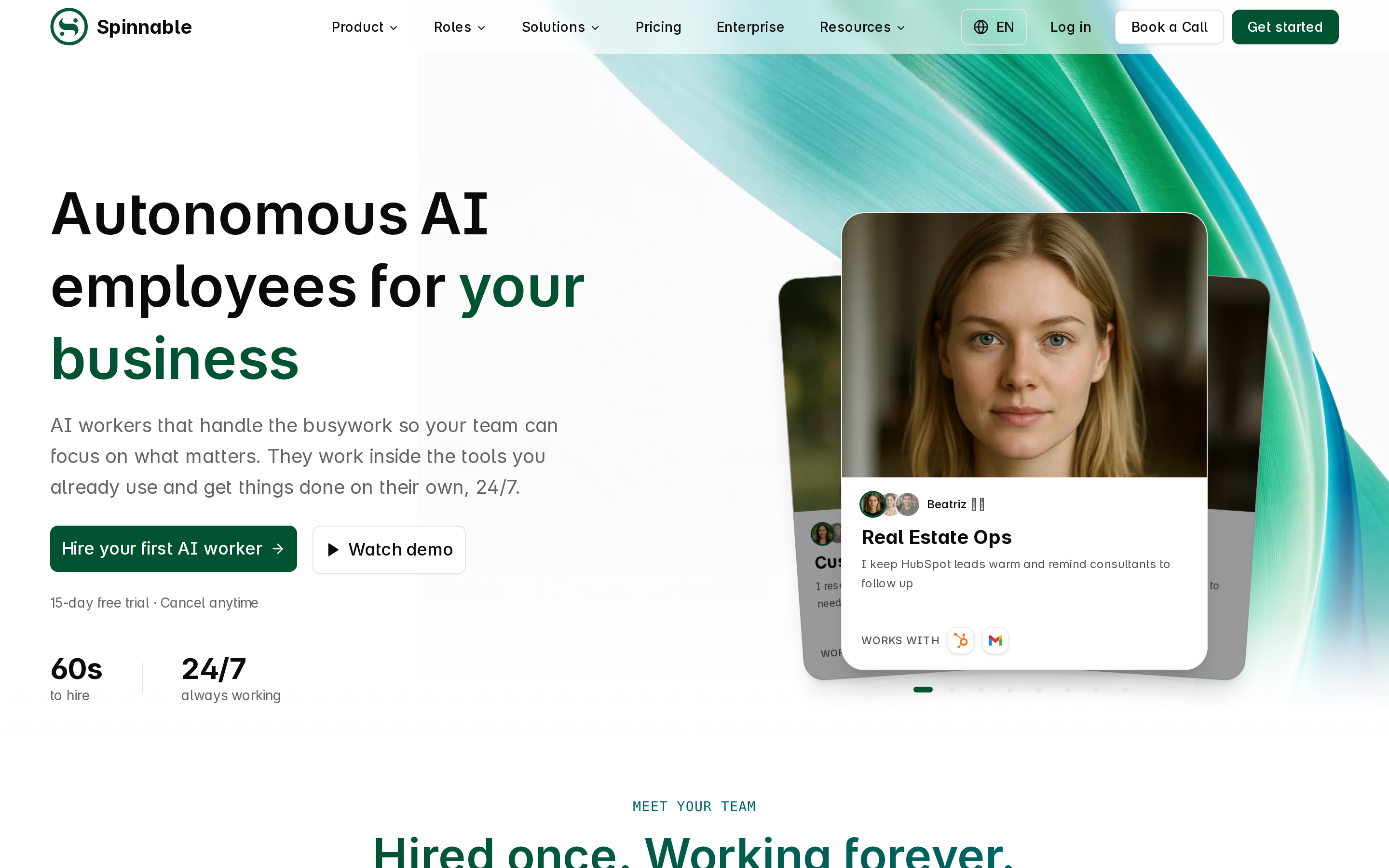
What it does: Spinnable provides an enterprise platform for deploying managed autonomous AI agents that handle operational roles across customer messaging, sales outreach, and internal support directly within tools like Slack, WhatsApp, and HubSpot.
Best for: Operations leaders wanting turn-key AI agent workforces deployed into active communication channels with governance oversight.
Factual pros:
- Turn-key agent deployment without extensive custom backend infrastructure engineering.
- Native multi-channel communication across business messaging apps and CRMs.
- Built-in approval rules for high-risk external messages or data modifications.
Factual cons:
- Managed architecture offers less raw low-level graph code customization than open-source frameworks.
- Requires active team subscription for cloud agent execution.
Publicly verified pricing model: Spinnable uses structured subscription packages scaled by active worker roles and enterprise usage volume. Official packaging is published on Spinnable.ai.
Non-fit scenarios: Engineering teams seeking an open-source self-hosted Python library for raw script development without cloud platform management.
2. Relevance AI: Best for low-code B2B AI agent building and team workflow execution
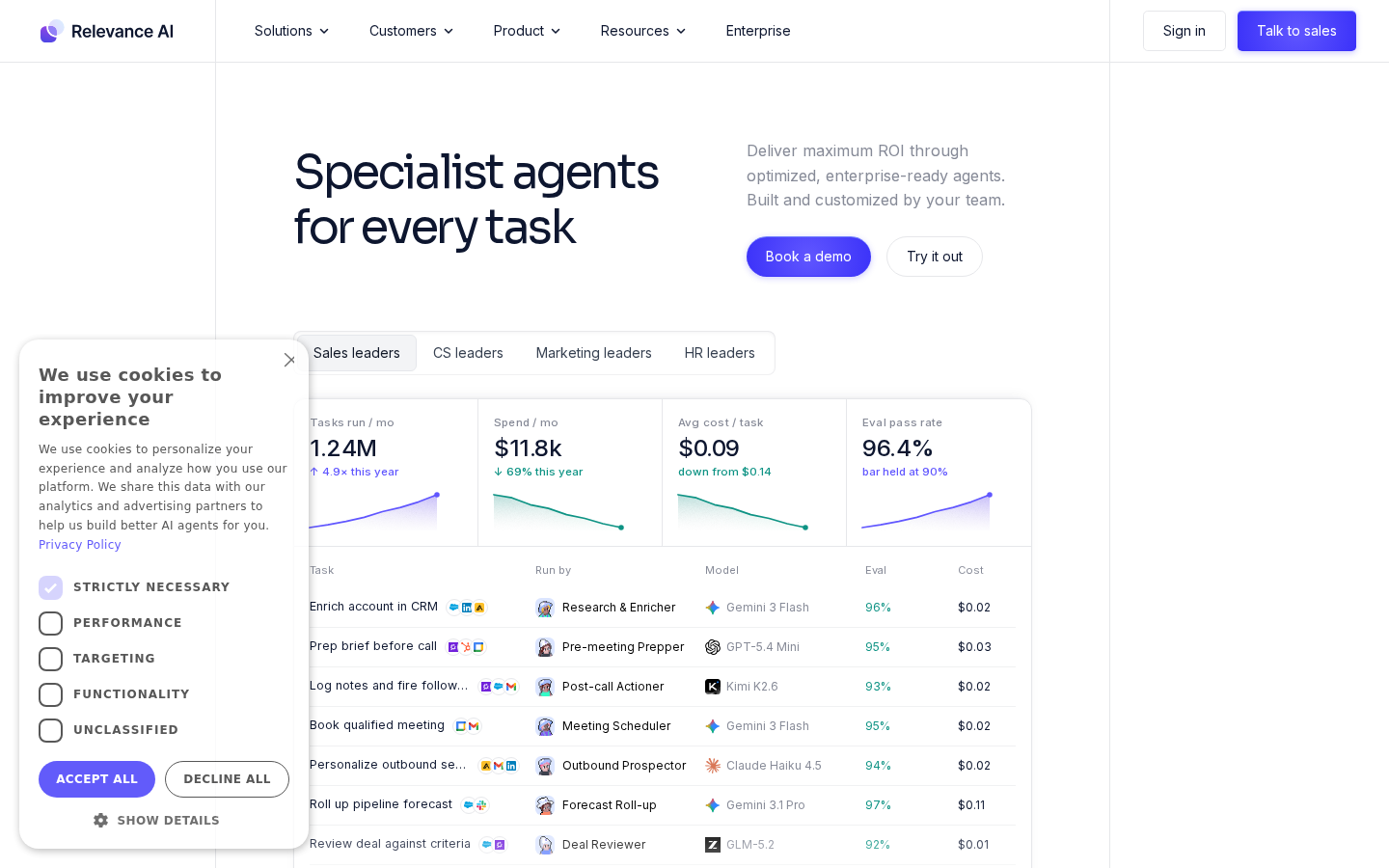
What it does: Relevance AI offers a low-code builder enabling B2B teams to construct custom AI agents, equip them with specialized tools, and run batch workflows across sales and operational data.
Best for: Non-developer ops teams wanting to build custom multi-step agents using a visual interface.
Factual pros:
- Intuitive visual builder for composing multi-step agent actions.
- Flexible tool creation allowing web scraping, API calls, and LLM switching.
Factual cons:
- Credit consumption based on step usage requires monitoring on complex workflows.
- Advanced state persistent memory management requires deliberate schema design.
Publicly verified pricing model: Free plan available with daily credit allotments; paid team plans start at $199 per month.
Non-fit scenarios: Software developers requiring code-native Git-versioned DAG graph frameworks.
3. Zapier AI Agents: Best for integrating AI agents across 6,000+ app ecosystems
What it does: Zapier AI Agents allows users to create autonomous bots that leverage Zapier's extensive library of 6,000+ app connections to perform automated tasks on demand.
Best for: Teams already heavily reliant on Zapier automations seeking conversational or autonomous AI extensions.
Factual pros:
- Instant access to 6,000+ software integrations in the Zapier ecosystem.
- No-code configuration setup accessible to non-technical staff.
Factual cons:
- Task executions draw from Zapier account task quotas, increasing costs on high-frequency loops.
- Limited native support for complex stateful reasoning graphs.
Publicly verified pricing model: Bundled into standard Zapier subscription tiers, with add-on options based on agent usage volume.
Non-fit scenarios: Organizations requiring self-hosted infrastructure or advanced local LLM model hosting.
4. LangGraph Platform: Best for developer code-first multi-agent DAG orchestration
What it does: LangGraph (developed by LangChain) provides a code-first framework and cloud platform for engineering stateful, multi-agent applications using directed acyclic graphs (DAGs) in Python and TypeScript.
Best for: Software engineers and AI developers building custom, complex agentic applications requiring precise control over state and execution loops.
Factual pros:
- Full code-level precision over agent memory, routing, and branching logic.
- Built-in state checkpointing enabling time-travel debugging and human-in-the-loop pauses.
Factual cons:
- Requires skilled software engineering experience in Python or TypeScript.
- No out-of-the-box non-technical user interface for end-business users.
Publicly verified pricing model: Open-source framework is free; cloud deployment platform offers a free developer tier and enterprise pricing upon contact.
Non-fit scenarios: Non-technical business operations teams seeking immediate no-code agent deployment.
5. CrewAI Enterprise: Best for role-based multi-agent team orchestration
What it does: CrewAI offers a framework for orchestrating teams of autonomous AI agents, where each agent is assigned specific roles, tools, and goals to collaborate on complex projects.
Best for: Engineering teams building collaborative multi-agent systems where agents hand off specialized sub-tasks to complete a broader workflow.
Factual pros:
- Clean conceptual framework for assigning distinct roles and goals to individual agents.
- Support for both sequential and hierarchical multi-agent collaboration patterns.
Factual cons:
- Requires Python coding for agent definition and custom tool setup.
- Enterprise management cloud features require commercial licensing agreements.
Publicly verified pricing model: Open-source core library is free under MIT license; Enterprise enterprise management platform requires contacting sales.
Non-fit scenarios: Business units seeking no-code, pre-built turnkey digital workers without software engineering.
Evaluating AI agent platform architecture
Choosing an AI agent platform involves balancing developer flexibility against operational time-to-value. For broader context on pre-configured worker options and individual assistant tools, review our detailed guides on best digital employees and best AI agents.
Frequently asked questions
What is the difference between an AI agent platform and an AI worker platform?
An AI agent platform provides building blocks and orchestration tools to create agents. An AI worker platform delivers managed, pre-configured roles complete with governance, approval controls, and business channel integrations ready for operational deployment.
How do human-in-the-loop controls function on agent platforms?
Human-in-the-loop controls allow developer or operational managers to pause agent execution state before critical actions occur, requiring manual human approval via UI or API callback before proceeding.
Can developer frameworks like LangGraph be integrated into Spinnable?
Yes. Custom agent logic built using developer frameworks can connect into enterprise platforms like Spinnable via webhook endpoints and API tools.
Scale your enterprise agent workforce with Spinnable
Bridge the gap between agent building and business execution with Spinnable's managed AI workforce platform.